
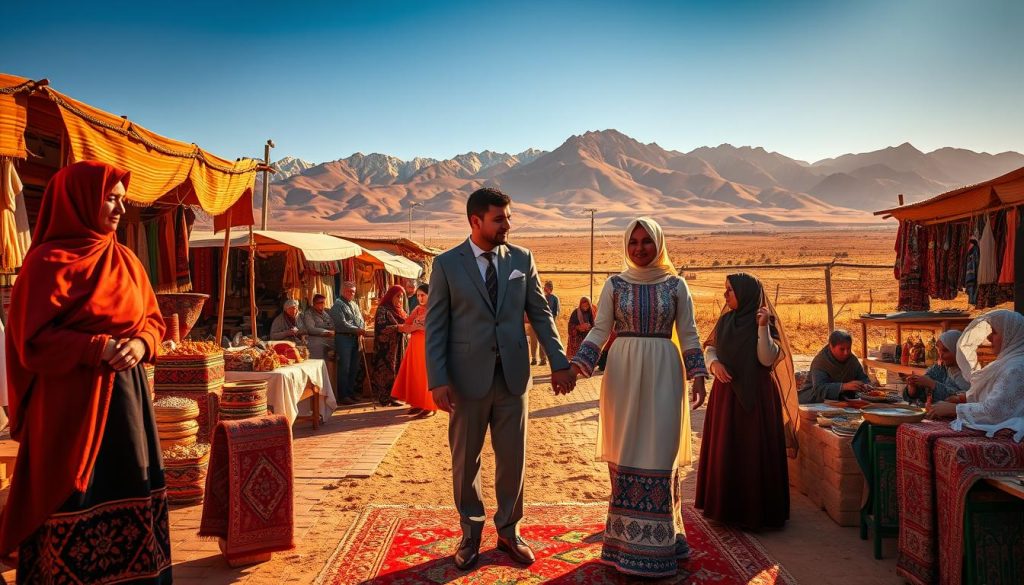
What if the most unforgettable window into Moroccan culture isn’t in Marrakech or Fes? But in a small High Atlas town you have to earn with every curve of the road?
Imilchil sits high in Morocco’s Eastern High Atlas. The air is thin, the pace is slow, and your arrival feels like a quiet rite of passage. If you want to visiter le maroc beyond the usual routes, this is where the journey itself becomes part of the story.
Each September, engagement season brings families together in a communal gathering tied to la culture marocaine, not a staged show for cameras. It’s recognized far beyond the mountains, yet it still runs on local rules, shared respect, and community oversight.
In this guide, you’ll learn when to go, how to reach Imilchil from major gateways, and what actually happens during the engagement season and the High Atlas Music Festival. You’ll also get practical tips on respectful behavior, where to stay and eat, and what to add to your route, including Isli and Tislit Lakes and Akhiam Cave.
Key Takeaways
- You’ll experience Moroccan culture in a high-altitude community where travel is slower and more immersive.
- Engagement season in Imilchil happens in September and is rooted in long-standing social custom.
- This is a how-to guide built for U.S. travelers planning to visiter le maroc with cultural depth.
- You’ll get clear expectations on what you’ll see, and what common myths get wrong.
- You’ll learn how to plan your route, timing, and lodging for a smoother mountain trip.
- You’ll find nearby highlights that complement la culture marocaine, including lakes and a famed cave.
Why Engagement Season in Imilchil Belongs on Your Morocco Itinerary
Imilchil’s engagement season is a cultural gem. It’s not a staged show but a real tradition in the High Atlas. For those planning tourisme au maroc, this experience turns a trip into a memorable story.
What makes this High Atlas gathering different from a typical festival
The pace here is slow and community-led. It’s not about loud branding or choreography. The heart of the season is the village square, where people meet and observe local customs.
This event is also known as the Imilchil Engagement Season and High Atlas Music Festival. It’s a reason many visitors say they truly explorez le maroc by leaving the city behind.
How the season supports tourisme au maroc and sustainable local development
Recent editions focus on heritage and local development. The 2025 edition, organized by Akhi Am Association, aims to protect High Atlas customs. It values cultural and environmental heritage as economic drivers.
This focus is seen in temporary markets and local products. Imilchil stands out as a place where your visit supports community livelihoods, not just sightseeing.
What you can realistically expect as a U.S. traveler
Expect Ahidous music, Amazigh clothing, and a lively town. Moroccan and international visitors add to the excitement. Some editions feature a traditional collective wedding ceremony.
Don’t expect sensationalism. Engagements are about community respect and privacy. Formal legal steps follow Moroccan processes. For U.S. travelers, listening is as important as taking photos.
| What you see in Imilchil | How it typically feels | Why it matters for your itinerary |
|---|---|---|
| Village-square gatherings and open meeting areas | Calm, observant, and guided by local etiquette | Adds depth to tourisme au maroc beyond headline attractions |
| Ahidous music, group dancing, and Amazigh dress | Participatory and seasonal, not over-produced | Helps you explorez le maroc through living cultural practice |
| Temporary markets, crafts, and regional products | Practical and community-focused | Supports local development while you visit meilleurs endroits à visiter au maroc |
Where Imilchil Is and What the High Atlas Setting Means for Your Trip
Imilchil is deep in Morocco’s mountain heart. Looking at the map changes your plans. Roads twist through valleys, making travel time vary with weather and daylight.
Traveling here rewards patience and smart planning. If you want to see Morocco beyond big cities, Imilchil is perfect.
Imilchil at nearly 2,150 meters in Morocco’s Eastern High Atlas Mountains
Imilchil sits at nearly 2,150 meters in the Eastern High Atlas Mountains. The high altitude means thinner air, bright sun, and cooler nights. Pack layers, drink plenty of water, and acclimate slowly.
The setting influences your activities and pace. Short trips take longer, and photo stops are common. The High Atlas adds a rugged edge to your Moroccan adventure.
Administrative context: Imilchil commune, Midelt Province, Drâa-Tafilalet
Knowing the area’s organization helps with planning. Imilchil is the center of the Imilchil commune, in Midelt Province, Drâa-Tafilalet region. This information helps with directions, transport, and route confirmation.
Services are basic, with limited supplies during busy times. Plan your fuel, snacks, and cash before ascending.
Local scale: about 9,164 residents (Morocco’s 2024 General Census of Population and Housing)
Imilchil has about 9,164 residents, according to the 2024 census. This small community affects your search for accommodations, drivers, and restaurant hours. In peak times, options can fill up quickly.
Use this guide to match your expectations with the mountain reality while exploring Morocco.
| What you’re planning | What the High Atlas setting means | Practical move for you |
|---|---|---|
| Travel time between towns | Mountain roads are scenic but slow, with switchbacks and changing visibility | Start early, avoid driving after dark, and keep buffer time for stops |
| Comfort at altitude | Cool nights and thinner air can affect sleep and energy | Pack layers, hydrate often, and keep your first day flexible |
| Lodging and meals | Limited inventory in a small population center, especially during busy dates | Confirm bookings ahead and carry backup snacks and water |
| Shopping and essentials | Fewer stores and narrower product variety than major hubs | Bring medications, warm gear, and cash before heading up |
| Trip style | The route itself becomes part of the experience, not a shortcut | Plan viewpoint stops and treat the drive as one of the attractions au maroc |
With the geography clear, focus on the experience. The mountains set the pace, bringing you closer to Moroccan culture than a fast itinerary.
Best Time to Go: September Weather, Crowds, and Festival Timing
Imilchil’s mountains dictate the best time to visit. September offers culture, clear roads, and a lively village. Be flexible with your plans, as dates might change by a few days.
Why September is the peak season for voyage au maroc and cultural travel
September brings Imilchil to life. You’ll see Amazigh dress, hear Ahidous rhythms, and find pop-up stalls. It’s like a temporary town.
The 2025 edition starts on a Thursday in Bouzmou and Imilchil. It features cultural and artistic events. This is the best time to see Morocco’s traditions.
But, expect more people and higher prices. Guesthouses will be full, and prices might go up. Weekends are especially busy.
What happens as winter approaches: road closures and isolation risks
After the festival, the weather can change quickly. Snow and ice can make travel harder, and roads might close without warning.
If you’re driving, plan carefully. A short trip can turn into a long one. Small towns can feel isolated during storms.
Alternatives to September: spring and summer for hiking and open mountain roads
Spring and summer offer easier travel and more daylight. These seasons are perfect for hiking, biking, and walks in the High Atlas.
Outdoor lovers will enjoy these seasons. You can explore Morocco’s beauty at your own pace. The altitude views and local markets are still available.
| Season | Road access | Village feel | Best fit for you |
|---|---|---|---|
| September | Usually the most reliable for reaching Imilchil by road | Busy, with visible cultural gathering and temporary markets | Culture-first trip planning and festival timing |
| Spring | Generally open, with fewer weather disruptions than late fall | Quieter, more day-to-day local rhythm | Hiking, photography, and wider regional drives |
| Summer | Typically open, with longer days for mountain routes | Calmer center, more time on trails and lakeside stops | Active travel and longer outdoor days at altitude |
| Late fall into winter | Higher risk of closures and delays from snow and ice | Low crowds, but more logistical constraints | Only if you’re prepared for changing conditions and backup plans |
How to Get to Imilchil From Major Airports and Cities
Planning to visit Morocco and reach Imilchil? Think of it in two parts: fly in, then drive up the High Atlas. A mountain town is a great place to stop for fuel, snacks, and cash.
Closest air gateways: Marrakech Menara Airport and Beni Mellal Airport
Marrakech Menara Airport is a top choice for U.S. travelers, with more flights and easy car rentals. Beni Mellal Airport is closer if you’re heading to central Morocco.
After landing, rent a car, take a bus, or mix taxis and buses. Make sure to have daylight for the mountain drive, as curves and animals on the road can slow you down.
Key transit hubs before the mountains: Midelt or Beni Mellal
Midelt is a key stop where roads meet before the mountains. It’s good for checking road conditions, fueling up, and getting water for the journey.
Beni Mellal is another important hub, especially if you start on the plains. From here, you’ll switch to quieter roads as the mountains get steeper.
Driving from Midelt: about 197 km, typically over three hours via N13/N29 and P317
The drive from Midelt to Imilchil is 197 km and takes over three hours. You’ll follow N13 and N29, then P317 as the landscape gets rougher.
Drive safely and plan short stops. On this road, passing safely is more important than speed.
Driving from Beni Mellal: about 161 km via P3204/P3208 then N12
From Beni Mellal, the drive is about 161 km via P3204 and P3208, then N12. It’s shorter but still takes time on the mountain sections.
For a public transport option, ask about the “double-transport” service. This combines buses and shared taxis from Midelt, Beni Mellal, or Errachidia. If starting from the southeast, Er-Rich near Errachidia is 138 km from Imilchil, fitting well into a desert-to-mountain trip.
| Start Point | Typical Route | Approx. Distance | What to Expect on the Road |
|---|---|---|---|
| Marrakech Menara Airport | Drive or bus toward Midelt, then continue to Imilchil | Varies by your hub choice | More services early on; longer day if you push to the mountains |
| Beni Mellal Airport | Beni Mellal → P3204/P3208 → N12 → Imilchil | ~161 km | Quicker access to the High Atlas; slower pace once roads narrow |
| Midelt (hub) | N13/N29, then P317 to Imilchil | ~197 km | Common staging stop; long curves and village pass-throughs |
| Er-Rich (near Errachidia) | Shared taxi/bus connections toward Imilchil area | ~138 km | Useful southeast approach; confirm drop-off points before you depart |
Moroccan culture in Imilchil: Amazigh Heritage and Community Traditions
In Imilchil, Moroccan culture is seen in everyday moments. A simple greeting, a cup of tea, or a long conversation can be memorable. The high altitude here influences daily life, making community and tradition strong.
Who you’ll meet
The Aït Haddidou tribe is key to Imilchil’s identity. You might also hear about Aït Yaazem, Tilmi, and others. These groups are part of the Amazigh heritage.
Meeting these communities shows Moroccan culture is more than just sights. It’s about language, family, and respect for visitors.
How land and seasons shaped traditions
Life in the mountains is tough, leading to cooperation. The Aït Haddidou developed shared grazing and dispute resolution. Their semi-nomadic lifestyle was shaped by the seasons.
“Imilchil” is remembered as a place for measuring grains in winter. This practice helped settle the area, focusing on farming and herding.
| Tradition shaped by terrain | What you may notice in Imilchil | Why it matters to Moroccan culture |
|---|---|---|
| Seasonal grazing routes | Talk of pasture timing, herd care, and weather watching | Connects daily life to land stewardship and shared planning |
| Azref (customary law) | Clear norms around conduct, mediation, and community balance | Shows how local governance supports stability in remote areas |
| Communal solidarity | Neighbors pooling labor and resources during busy periods | Reveals la culture marocaine through reciprocity, not spectacle |
A corridor, not a sealed-off village
Imilchil was never isolated by the mountains. It was a key stop on routes from Tafilalet to the plains. This history explains why local traditions are rich and diverse.
Exploring Imilchil, you’ll find more than just main attractions. Look for weekly markets, ancient paths, and stunning views. This is Moroccan culture: real, social, and influenced by the High Atlas.
Understanding the Engagement Season: What Happens and How It’s Organized
In Imilchil, the engagement season is a community event with clear rules. It’s a chance to see Moroccan culture in the mountains, not a show for outsiders. If you’re looking for things to do in Morocco beyond big cities, this is a unique opportunity.

The communal setting: a regulated space for meeting under community oversight
The idea is simple: people meet in a controlled space. Families and community leaders are nearby. It’s structured, public, and follows local norms.
You might hear stories about free mixing and warm tea. But the atmosphere is more guided than random.
What you’ll see: Ahidous music, Amazigh attire, and a central-square gathering
The central square is the main spot, with people moving and small groups forming. You’ll see men in wool djellabas and women in colorful Amazigh clothes. Ahidous music fills the air, making everyday actions feel communal.
Temporary markets add a practical touch. You’ll see produce, livestock, and wool carpets. For U.S. travelers, this is a vivid and grounded experience.
What’s commonly misunderstood: no “spontaneous marriages” and no women “on display”
Two myths need clearing up before you go. First, there are no “spontaneous marriages.” Second, women are not “on display.”
What you’re seeing is a structured affirmation of social life. Privacy and dignity are protected by the same rules that give the event its meaning. Seeing Moroccan culture here means noticing what’s not happening, as much as what is.
How legal formalities work: Adoul travel to Imilchil to formalize marriage contracts locally
Engagements are often described as prearranged, with family talks going on beyond public events. When couples are ready, Adoul come to Imilchil to formalize contracts. This local access can save couples a long trip to Er-Rich for paperwork.
| What you might hear | What you can expect on the ground | Why it matters to your visit |
|---|---|---|
| “It’s a free-for-all where everyone pairs off quickly.” | A regulated communal space with community oversight and clear social limits. | You’ll read the setting more accurately and behave with respect. |
| “Marriages happen spontaneously during the event.” | No spontaneous marriages; discussions and timing extend beyond the square. | You’ll avoid repeating myths that flatten la culture marocaine. |
| “Women are put on display for tourists.” | No women “on display”; attire and presence reflect local identity and choice. | You’ll focus on observation, not intrusion, while engaging Moroccan culture. |
| “All paperwork requires travel to a larger town.” | Adoul travel to Imilchil to formalize contracts locally, reducing trips to Er-Rich. | You’ll understand how the season connects to real civic and legal life. |
The Modern Festival Program: Music, Markets, and Sustainable Tourism
In 2025, the Imilchil Engagement Season and High Atlas Music Festival opened in Bouzmou and Imilchil, in Midelt Province. They have a clear, posted schedule. This makes planning easier for visitors without losing the local feel.
The program is run by the Akhi Am Association with local communes and Midelt provincial authorities. The theme is “Authentic Heritage and Sustainable Tourism Serving Local Development,” showing tradition and local income opportunities. It’s a great example of community-led attractions au maroc.
There are folk music performances from different parts of Morocco, craft and local product exhibitions, and academic seminars. Sports competitions and youth activities are also part of the festival. This means you can enjoy more than just stage events as you explorez le maroc.
The temporary market is a key part of the experience. You’ll find carpets, wool goods, agricultural items, and small-batch foods. Shopping here supports local trade and tourism, making tourisme au maroc a success in mountain hubs like Imilchil.
| Program Piece | What You Experience | How to Plan Your Time | Why It Matters Locally |
|---|---|---|---|
| Folk music performances | Rotating sets that highlight regional rhythms and group dance traditions | Arrive early for seating and stay after for casual mingling in the main gathering areas | Creates paid stages for artists and keeps heritage visible for attractions au maroc |
| Craft and local product exhibitions | Textiles, carpets, wool items, and seasonal mountain goods presented by local sellers | Bring small bills, ask about materials, and pack a tote for fragile purchases | Turns skills into steady sales and supports households tied to pastoral life |
| Academic seminars | Short talks and discussions that explain cultural practices and local development goals | Use these sessions to set context before you explore markets and performances | Helps visitors explorez le maroc with better understanding and fewer stereotypes |
| Sports competitions | Community games that draw families and visiting spectators | Go mid-day when crowds spread out and the atmosphere is relaxed | Adds shared pride and brings spending to nearby vendors |
| Youth activities | Organized events aimed at teens and young adults, often tied to arts and community life | Look for posted times so you don’t miss limited-run activities | Keeps the festival future-facing while staying rooted in local customs |
The modern program adds structure to your visit. It packages music, crafts, and environmental identity into a visit you can follow. It supports local economic activity and community oversight. For many U.S. travelers, this balance makes these attractions au maroc feel both real and welcoming as you explorez le maroc.
Isli and Tislit Lakes: Legend, Landscapes, and Photo-Worthy Attractions
If you’re looking for quiet views, the twin lakes near Imilchil are perfect. They offer stunning views without a long drive. These high-altitude waters feel remote but are close enough to town for an easy trip.
Many travelers say these lakes are among the best places to visit in Morocco. You get to see mountain light, open skies, and a strong sense of place.

Where they are: approximately 14 km and 7 km from Imilchil’s center
Tislit Lake is about 7 km from Imilchil’s center. It’s great for a visit before lunch or near sunset. Isli Lake is about 14 km away. It fits a half-day loop with photo stops.
In the High Atlas, short distances can feel longer. So, plan for rough shoulders, herds on the road, and quick weather shifts.
| Lake | Distance from Imilchil center | Best fit for your schedule | What you’ll notice on arrival |
|---|---|---|---|
| Tislit | About 7 km | Quick visit between festival events | Steep slopes, calm shoreline pockets, strong reflections in mild wind |
| Isli | About 14 km | Half-day outing with more stops | Broader basin, wide horizons, changing color tones as clouds move |
The lovers’ legend and how it shapes the season’s storytelling
Locals tell a story of the lakes born from a love blocked by rival tribes. In one version, the couple’s tears filled the basins; in another, they drowned by suicide. The gathering honors their memory.
This story travels with the engagement season. It speaks to reconciliation and community ties. It makes the lakes more than scenery, which is why they stand out among attractions au maroc.
How to visit respectfully and safely at high altitude
At roughly 2,150 meters near Imilchil, you’ll feel the altitude if you rush. Walk slowly at first, drink water often, and pack a warm layer even on bright days. Light can be intense, so sun protection matters as much as a jacket.
- Keep it low-impact: stay on existing paths and avoid trampling fragile lakeside plants.
- Read the moment: if families are nearby, give space and ask before taking close photos.
- Plan for the road: start earlier than you think, carry snacks, and keep your fuel margin comfortable.
Handled with care, Isli and Tislit become some of the best places to visit in Morocco. They offer clear air, local meaning, and a landscape that doesn’t need a filter.
Where to Stay and What to Eat During Your Vacances au Maroc in Imilchil
Imilchil is simple yet beautiful. It has clear air, quiet nights, and cool mornings. When you plan your vacances au maroc, remember the altitude and pack layers. The Eastern High Atlas rewards those who stay close to the action, like lakes and village life.
Typical lodging costs
Rooms in and around Imilchil cost 300–600 MAD per night. Prices may go up in September with the engagement season. But, spring and winter can be cheaper, though nights are colder and services might be less.
Check what’s included in your stay. Heating, dinner, breakfast, and parking can affect the price. A bit more money might get you a warmer room and a reliable hot shower.
Best stay styles
Your stay should match your daily life and how close you want to be to the action. Staying by the lakes or in the village center offers different experiences of la culture marocaine.
| Stay style | Best for | What it feels like | Trade-offs to plan for | Typical nightly range (MAD) |
|---|---|---|---|---|
| Lakeside guesthouses | Sunrise walks and quick access to Isli/Tislit viewpoints | Quiet mornings, big skies, crisp air | Fewer shops nearby; dinner options may be limited | 450–700 (often higher in September) |
| Village-center lodgings | Easy access to the central gathering area and daily markets | Community energy and practical convenience | More noise during peak nights; parking can be tight | 300–600 |
| Quieter inns on the edge of town | Rest, early departures, and a calmer schedule | Low-key evenings and darker skies for stargazing | You may need a ride to meals and busy areas | 350–550 |
| Rental homes | Families and groups who want space and privacy | More control over meals and downtime | You’ll handle shopping, timing, and heating details | 500–900 (varies by size and season) |
What to order
Food in Imilchil is made for the mountains. After Marrakech, the evenings can get chilly fast. Warm and filling dishes are a must.
- Tagines with meat and spiced vegetables that stay hot and satisfying.
- Couscous with wheat grains and seasonal produce for a steady, comfort-food meal.
- Warming soups that help you settle in after a windy afternoon.
- Moroccan pastries when you want something sweet after dinner or with morning tea.
Exploring la culture marocaine through food? Keep it simple. Ask for fresh ingredients and what locals are eating. On cool nights, meals that arrive steaming are a blessing.
Things to Do Beyond the Festival: Caves, Hiking, and Local Markets
When the main square gets busy, you can still explorez le maroc at a slower pace. The High Atlas around Imilchil rewards early starts, steady walking, and short drives. These side trips add variety to your list of choses à faire au maroc without pulling you far from town.
Akhiam Cave (about 40 km away): “Takhant Imeskhr Rebbi” and the petrified-family legend
Akhiam Cave sits about 40 km from Imilchil and is often introduced as “Takhant Imeskhr Rebbi,” or “the cursed family.” Locals may retell a wedding-day legend in which a family is turned to stone after a grave moral breach. It’s one of the most memorable attractions au maroc in this mountain zone, especially if you like stories tied to place.
Inside, you may be shown shapes linked to the tale: the Amghar, a fortress-like mass called Tazlaft, figures said to resemble Ahidous dancers, and the bride’s stirrup, Rkab. You don’t need to “see” the same details to enjoy it. The fun is listening, looking, and letting the cave set the pace.
The geology angle: stalagmites and limestone formations shaped by acidic water over millennia
What you’re viewing is also a long, slow science lesson. Stalagmites and limestone formations build up when slightly acidic water dissolves rock and redeposits minerals over millennia. In the dim light, natural deposits can read like faces, fabrics, and tools, so the cave becomes a quiet dialogue between geology and oral tradition.
Outdoor options: hiking, mountain biking, and shopping handcrafted wool carpets and local products
If you want fresh air instead of shade, pick a ridge walk or a valley route and keep your layers handy. Mountain biking is another strong option on the rugged tracks outside town, where altitude and wind can change your effort fast. For a lower-key afternoon, browse local markets for handcrafted wool carpets, agricultural goods, and local products you can pack home.
These outings round out your attractions au maroc list with everyday texture—bread ovens, dye tones in wool, and seasonal produce. If your goal is to explorez le maroc beyond headline moments, this is where Imilchil feels most personal.
How to plan a day trip that fits with festival schedules and mountain road conditions
In September, the central program can run full: music, exhibitions, seminars, and sports or youth events. Plan your cave visit or long hike early, then return to town before the late-day rush. Build extra time into your drive, since mountain curves slow everything down.
As winter approaches, snow and road closures can affect day-trip reliability. Ask about conditions the same morning, carry water, and keep a warm layer close. With that rhythm, you can balance the festival with more choses à faire au maroc that still feel grounded and safe.
| Experience | Time You Should Budget | What You’ll Notice | Best Fit With Festival Days |
|---|---|---|---|
| Akhiam Cave (Takhant Imeskhr Rebbi) | Half day (drive + visit) | Story markers like Amghar, Tazlaft, Ahidous-like shapes, Rkab | Morning trip, back for afternoon programming |
| High Atlas hike near Imilchil | 2–5 hours | Thin air, big views, quick weather shifts | Best on days you want fewer scheduled stops |
| Mountain biking on rugged tracks | 2–4 hours | Loose gravel, steep grades, strong winds | Early start to avoid peak crowd movement |
| Local market browsing | 1–2 hours | Handcrafted wool carpets, local foods, practical mountain goods | Late morning or evening after shows and talks |
Conclusion
If you’re looking for authentic Moroccan culture, Imilchil’s engagement season is the place to be. You’ll find yourself at high altitude, where time moves slower and plans need more thought. For U.S. travelers eager to explore Morocco meaningfully, Imilchil stands out as a top destination.
In September, the town comes alive with Ahidous music, traditional Amazigh clothing, and bustling markets. These markets are more for locals than tourists, adding to the authenticity. The festival supports preserving heritage and promotes sustainable tourism, keeping the community genuine.
Don’t miss the chance to visit Isli and Tislit Lakes for their vast skies and peaceful shores. Akhiam Cave combines legend and geology, making for an unforgettable experience.
Plan your trip for September to catch the cultural peak. Travel through Midelt or Beni Mellal before reaching the Eastern High Atlas. Choose your transport wisely, considering the mountain roads. Book your lodging early, as options are limited and prices increase quickly.
Imilchil will leave a lasting impression on you. It teaches patience through its vast landscapes and calm beauty. If you’re seeking genuine Moroccan culture, Imilchil remains a benchmark for the best places to visit in Morocco.